
Good, Cheap, Fast
When Everything Becomes a Priority

I was drowning in impossible choices. My friend and I had just started importing speciality architectural material, distributing across the US and Canada from our tiny operation. Every decision felt critical—one wrong move with our fragile cash flow, limited time, and non-existent margin for error could sink everything. We needed to move fast, keep costs low, and somehow maintain quality, all at once.
One day over the weekend, as I was visiting a nice little shop in a beautiful, quaint town, I stumbled across a sign that stopped me in my tracks.
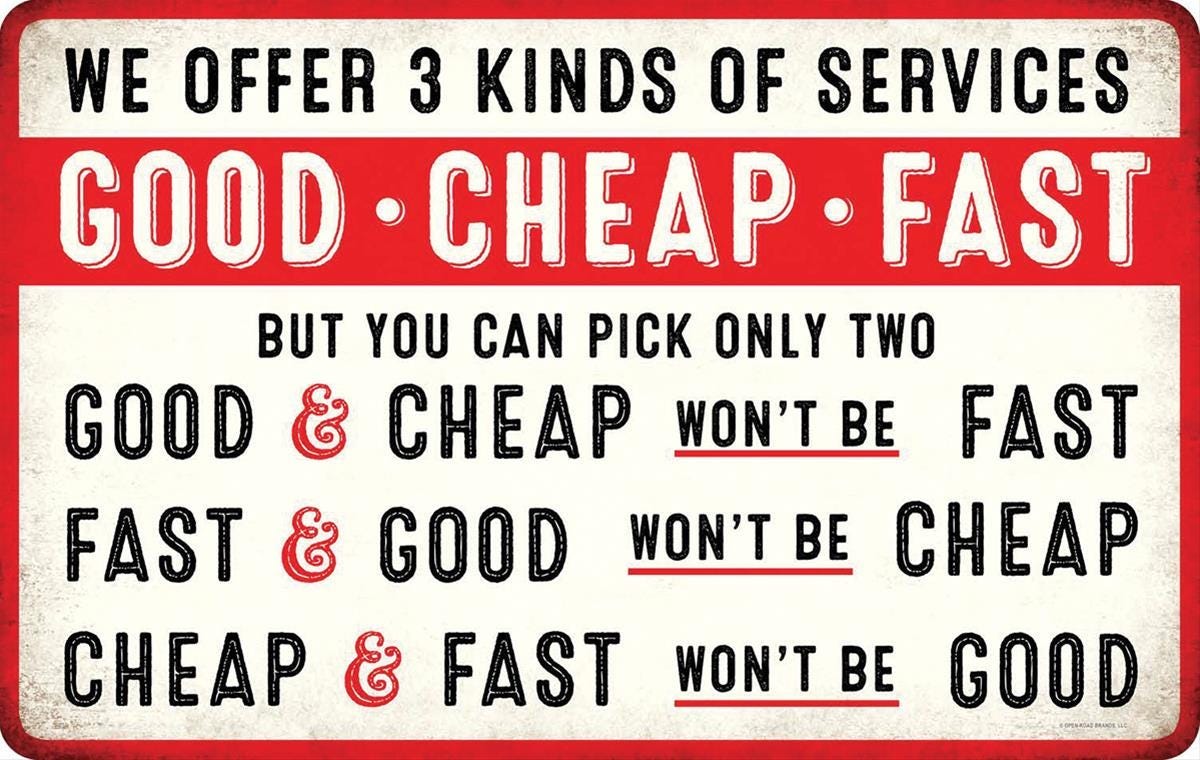
I chuckled and kept walking. But something about this cheeky gag wouldn't let go.
By the time I got home, I realized that joke wasn't a joke at all—it was the most honest thing any business had ever told me. More importantly, it perfectly captured the impossible situation we'd been wrestling with every single day.
I started using it immediately. When prospects demanded the impossible—flawless work, lightning delivery, bargain pricing—I'd lean back and smile.
"You know that old saying about good, cheap, fast? Which two matter most here?"
Suddenly, unreasonable demands became actual conversations about priorities.
But the real breakthrough came when I turned it inward.
I wrote those three words on my office whiteboard and built what I called my "priority pyramid." I actually changed “Good” into “Perfect” to make it very clear to myself. At the impossible peak: Perfect + Cheap + Fast. Below that, the three achievable combinations, ranked by what my startup needed most.
Fast + Cheap sat at the top—we were burning runway and needed to test hypotheses quickly. Perfect + Cheap came next—when time allowed, we'd optimize without overspending. Perfect + Fast lived at the bottom—reserved for those rare moments when failure wasn't an option, regardless of cost.
The pyramid wasn't permanent. When we started pitching enterprise clients, Perfect + Fast jumped to the top. During product development phases, Perfect + Cheap ruled everything.
For every decision—hire a developer, choose a vendor, plan a launch—I'd glance at that whiteboard and ask: "Which two matter most right now?"
I have moved on from that entrepreneurial adventure many years ago, but last month, when a colleague asked me how I make decisions quickly, I told him about the little shop sign.
His next email signature read:
'Cheap, Perfect, Fast - Pick Two.’
🧑💼 The Business Reality
This Perfect-Cheap-Fast framework reveals one of the most persistent challenges in business: the illusion that we can have everything without trade-offs.
The Optimization Paradox
The human instinct: We want to optimize for everything simultaneously. More features, higher quality, lower costs, faster delivery, greater innovation, better safety—why should we have to choose?
The business reality: Resources are finite, time is limited, and physics still applies! Every choice to optimize one dimension necessarily constrains others. The refusal to acknowledge trade-offs doesn't eliminate them; it just makes them invisible until they create problems.
The irony is that leaders who try to avoid making trade-offs end up making them unconsciously and inconsistently, creating confusion and frustration throughout their organizations.
The Strategic Advantage
Organizations that master trade-off thinking gain several crucial advantages:
Clarity of Purpose When everyone understands which two dimensions matter most, decision-making becomes faster and more consistent. Resources flow toward clear priorities rather than being spread thin across competing goals.
Realistic Planning Acknowledging constraints upfront leads to better estimates, more achievable timelines, and fewer crisis situations caused by unrealistic expectations.
Resource Efficiency Instead of trying to optimize everything (and therefore optimizing nothing), focused investment on two dimensions creates meaningful competitive advantages.
Customer Alignment Different customer segments value different combinations of cheap, perfect, and fast. Clear trade-offs help you serve specific segments exceptionally well rather than serving everyone mediocrely.
Innovation Focus The most breakthrough innovations often come from deliberately sacrificing one dimension to excel dramatically on the other two. Trade-off clarity enables this kind of strategic sacrifice.
Common "Pick Any Two" Scenarios
The Product Development Trap
The fantasy: "We need a feature-rich product that's also simple to use, works perfectly out of the box, ships next month, and costs less than our competitor's basic version."
The reality: Feature-rich conflicts with simple. Perfect conflicts with fast. Low cost conflicts with comprehensive. Pick two.
The framework moment: Acknowledging that this iPhone-quality product with a six-week timeline means either spending significantly more on development resources or accepting a more limited feature set.
The Marketing Campaign Dilemma
The fantasy: "We need maximum reach, perfect targeting, measurable ROI, creative excellence, and we need to do it with a minimal budget by next week."
The reality: Maximum reach is expensive. Perfect targeting takes time to optimize. Creative excellence requires iteration. Pick two.
The framework moment: Deciding whether this campaign prioritizes speed and budget (broad, simple messaging) or quality and targeting (sophisticated, personalized approach).
The Hiring Challenge
The fantasy: "We need someone with extensive experience, who'll accept our startup salary, and who can start immediately."
The reality: Experienced talent commands market rates. Great candidates have options and notice periods. Budget-friendly hires often need training time. Pick two.
The framework moment: Choosing between paying market rates for immediate expertise, accepting a longer timeline for the right person, or investing in developing less experienced talent.
The Client Service Squeeze
The fantasy: "We'll provide white-glove service, competitive pricing, and lightning-fast turnaround for every client."
The reality: Premium service requires dedicated resources. Competitive pricing means tight margins. Fast turnaround demands excess capacity. Pick two.
The framework moment: Segmenting clients based on which two dimensions matter most to them, rather than trying to be everything to everyone.
The Growth Strategy Triangle
The fantasy: "We'll expand rapidly into new markets while maintaining our quality standards and keeping costs under control."
The reality: Rapid expansion strains systems. Quality maintenance requires careful oversight. Cost control limits investment in new capabilities. Pick two.
The framework moment: Deciding whether growth prioritizes speed and cost control (accept some quality dips during scaling) or quality and cost control (slower, more methodical expansion).

🧑🔬 The Science Behind Trade-off Denial
Research in cognitive psychology and behavioral economics explains why we consistently underestimate the reality of trade-offs:
Optimism Bias Documented extensively by Tali Sharot and others, optimism bias leads us to systematically overestimate positive outcomes while underestimating negative ones. Ola Svenson (1981) showed that over 90% of people believe they're above-average drivers, and similar patterns appear in project planning. This cognitive bias makes "having it all" seem more feasible than statistical reality suggests, with meta-analyses showing we underestimate project completion times by 20-50% on average.
Planning Fallacy and Complexity Kahneman and Tversky's research demonstrates that we consistently underestimate the time, cost, and complexity of projects, with the effect increasing as complexity rises. Buehler et al. (2002) found that people focus on idealized scenarios rather than considering the interdependencies between competing objectives. The more moving parts a project has, the more we underestimate how those parts will conflict with each other.
Attention and Resource Allocation Studies in cognitive load theory (Sweller, 1988) show that human attention is fundamentally limited. Research by Kahneman (1973) on attention as a finite resource explains why we underestimate the cognitive costs of juggling multiple priorities. We forget that excellence in any domain requires focused investment of limited mental resources.
Loss Aversion and Commitment Kahneman and Tversky's prospect theory demonstrates that people feel losses more acutely than equivalent gains. This makes acknowledging trade-offs psychologically painful—it feels like "giving up" something valuable rather than making a strategic choice. Studies by Thaler (1980) show we prefer maintaining multiple options (even inferior ones) over committing to single, superior choices.
Social and Organizational Pressures Research by Heath (1999) on organizational goal-setting shows that companies systematically reward ambitious targets over realistic planning. Studies of "goal inflation" demonstrate that teams face pressure to promise comprehensive outcomes rather than acknowledge constraints, creating systematic bias toward overpromising and under-delivering.
🧑🎨 The Art of Strategic Trade-offs
The key to effective decision-making lies in developing what we might call "trade-off clarity"—the ability to make constraints explicit and use them as decision-making tools rather than obstacles to ignore.
Make the Triangle Visible Before starting any project, explicitly identify the three competing priorities and acknowledge that you can optimize for only two. This prevents scope creep and unrealistic expectations.
Create Decision Frameworks Develop consistent criteria for how you'll make trade-offs in different situations. Startups might default to "fast + cheap." Luxury brands might choose "perfect + fast." Enterprise software might prioritize "perfect + cheap."
Communicate Trade-offs Early Share your trade-off decisions with stakeholders before problems arise. "We're prioritizing speed and budget for this launch, which means we'll need to iterate on features post-release."
Plan for Trade-off Shifts Recognize that priorities change over time and across different projects. The trade-offs that make sense today might not make sense tomorrow.
Use Trade-offs for Competitive Advantage Instead of trying to match competitors on all dimensions, consciously choose to excel on two while being adequate on the third. This creates sustainable differentiation.
💡The Key Insight
Constraints aren't limitations—they're clarity. The good-cheap-fast framework teaches us that the most powerful strategic tool isn't the ability to have everything, but the wisdom to choose the right priorities.
When you feel pressured to promise perfect, cheap, and fast delivery, remember that sign in the little shop. The best leaders don't try to eliminate trade-offs; they make them consciously, communicate them clearly, and use them as competitive advantages.
The next time someone asks for the impossible trinity, smile and say: "That's a great question. Which two matter most?" You'll be amazed how quickly impossible problems become manageable decisions.
Sometimes the smartest strategy is knowing what you're willing to give up.
This story has been anonymized to protect privacy, but the insights it contains are as real as the day they were discovered. Each one changed how I see some aspect of business, leadership, or life. I hope a few of them might do the same for you.