
Doing the Things Right, Doing the Right Things
Execution and strategic vision are two sides of the same coin: leadership

At the company Christmas party, a colleague turned to me and said: “We described our challenges to you, and your reaction was very relaxed. I’ve been wondering — do you have a really thick skin, or do you just not care?”
It stopped me cold. Because I did care. I cared deeply. But somewhere along the way, I had calibrated my altitude so high that what looked like a serious problem to my new team barely registered on my radar. I wasn’t indifferent. I was just flying too high to see the ground clearly.
To understand how I got there, let me go back to the beginning.

Early in my career, I was given a mission: deploy a telemonitoring solution across global markets. It was highly technical, full of interdependencies — regulatory, privacy, legal, supply chain, sales, IT. I had no playbook. I barely knew where to start.
I was lucky to work alongside Peter, an ops project manager from Jamaica who brought a remarkable calm to everything he touched. He was the smoothest operator I had ever seen. He taught me how to break a mountain into manageable steps. How to connect the different parties so nothing fell through the cracks. How to communicate progress and challenges in a way that kept everyone aligned and moving. How to solve problems without drama.
The first market was hard. Really hard. But when it was done, it felt like a genuine accomplishment — the kind that changes you a little. And then it made the next 18 markets so much easier. The structure had paid off. The effort had compounded.
I had learned to do things right.
It was around that time that my manager said something I didn’t fully understand until much later. We were in one of our regular check-ins, and I was walking him through the deployment — the tactical details, the blockers, the next steps. But I was also working with very senior stakeholders: legal, regulatory, privacy. People who didn’t want to hear about Gantt charts. They needed to understand the big picture, the implications, the risks at their level. I had learned, almost by instinct, to switch registers depending on who I was talking to.
My manager listened, then said: “One of your strengths is that you can fly the helicopter very high and have a clear overview of the situation. But you can also fly very close to the ground, deep into the tactics. And you are very good at alternating between the two.”
Something clicked. He had put words on something I had been doing instinctively, without naming it. I knew it was true the moment he said it. And I knew he valued it — which meant it wasn’t just a personal quirk, it was something worth developing deliberately. What had been instinct, I decided, would become method.
Years passed. More responsibility came. I went from deploying projects to deciding which projects deserved to exist. From tracking milestones to setting direction. The question shifted from how do we do this? to should we be doing this at all? I had crossed into the territory of doing the right things.
Then came the biggest assignment of my career. The largest medtech recall in our field. Tens of millions of devices. Patients. Regulators. Markets. Media. Everything at once, and nothing going smoothly.
My days were a relentless sequence of bad news — ten problems before lunch, each one seemingly unsolvable, many of them directly contradicting each other. Details still mattered enormously — a wrong move at the ground level could have serious consequences. But the sheer scale and pace of it demanded that I develop the high-altitude muscle like never before. You had to decide what mattered most, right now, with imperfect information and no time to think. You had to hold the big picture together when everything was trying to pull it apart. The senior people around me were exceptional, and together we covered the ground. But the direction — the constant reprioritization, the navigation through chaos — that was mine to carry.
It was the most intense experience of my professional life. And in a strange way, it worked.

Then it ended. And I moved on to a new role — a normal job, by most standards. A good team, reasonable challenges, no global crisis. Just work.
And I struggled.
Not dramatically. Not visibly, at first. But I noticed it. I was calibrated for a different altitude. Problems that were genuinely difficult for my new colleagues seemed manageable to me — not because they weren’t real, but because I had spent years navigating things that were catastrophically harder. I wasn’t bringing them calm. I was bringing them distance.
That is when my colleague asked me the question.
“Do you have a really thick skin, or do you just not care?”
It was said kindly. But it landed hard. Because it made me realize something: I had spent so long learning to fly high that I had lost the feel for the ground. The very discipline that had served me at the peak of my career was now getting in the way. I had to relearn how to fly low — how to see the details again, how to feel the weight of problems that weren’t existential but still mattered to the people living them.
The helicopter was still there. I just needed to remember how to land it.
🧑💼 The Business Reality
This tension isn’t unique to leadership transitions. It shows up everywhere — often without people recognizing it for what it is.
The founder who can’t let go of execution. They built the company by being the best executor in the room. They knew every detail, every customer, every line of code. But as the team grew, the same hands-on style that made them successful started holding the company back. They were so deep in the daily operations that they couldn’t see the strategic choices they were avoiding. They were doing things right — just not always the right things.
The senior leader who has lost touch with the ground. They set direction confidently, run smooth executive meetings, present clean slides. But when a front-line team member raises a concern, it doesn’t land. The strategic logic is sound, but it was built on assumptions that haven’t been tested against reality for months. The altitude is comfortable. The terrain below has shifted.
The high-potential manager asked to step up. They have spent three years delivering with precision and reliability. Now they’re told to “think more strategically.” But no one told them that means temporarily relaxing their grip on execution — and that the discomfort of doing so is not a sign of failure, but of transition. They keep diving back into the details because that’s where they feel competent. The altitude change feels like losing control.
The team caught between two modes. Half the room wants to discuss direction, the other half wants to discuss delivery. Both are right — just at different altitudes. The meeting spins because nobody has named which conversation they’re actually having.
In each case, the problem isn’t competence. It’s altitude awareness — knowing which level of thinking the situation requires, and whether you’ve drifted too far from the other one.
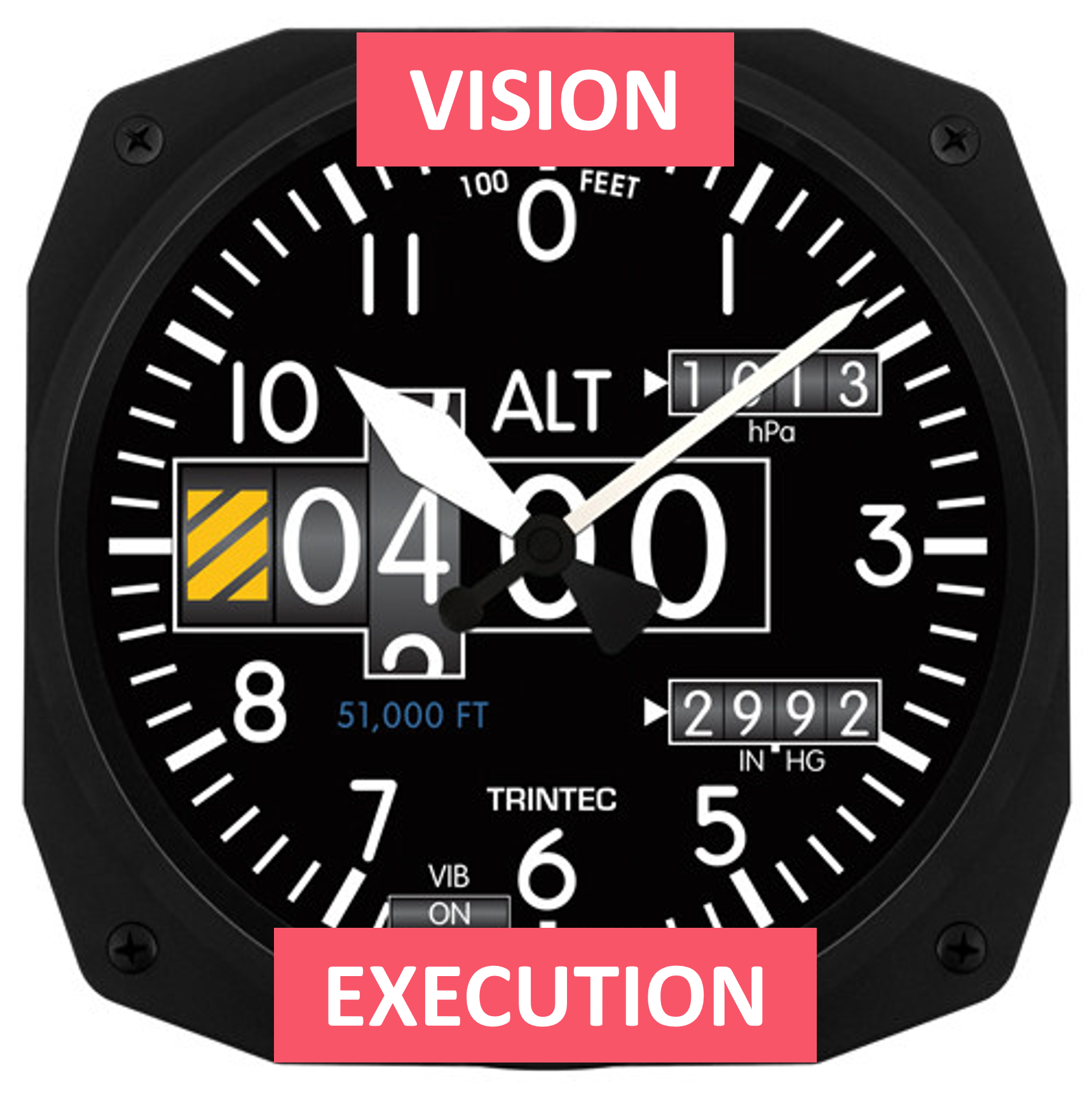
🧑🔬 The Science Behind Altitude Switching
The tension between strategic thinking and operational execution isn’t just a career challenge. It’s a cognitive one — and researchers have been studying it for decades.
Construal Level Theory, developed by psychologists Yaacov Trope and Nira Liberman at NYU, explains how our minds operate differently depending on psychological distance. When we think about something abstract, distant, or future-oriented, we use high-level construal — big picture, broad goals, general principles. When we focus on something concrete, immediate, and present, we use low-level construal — details, tactics, specific actions.
What’s critical is this: both modes are necessary, but they actively interfere with each other. Research by Förster, Friedman and Liberman (2004) showed that priming people with abstract thinking impairs their ability to notice concrete details — and vice versa. The brain doesn’t naturally hold both at once. It defaults to one, and the other goes quiet.
This is compounded by what neuroscientist Antonio Damasio calls the somatic marker hypothesis: as we accumulate experience in one mode of thinking, we develop automatic emotional responses that reinforce that mode. In other words, we don’t just become better at strategic or operational thinking — we become more comfortable with it, and increasingly uncomfortable with the other. The comfort zone is neurological, not just psychological.
A 2010 study published in the Journal of Experimental Social Psychology by Liberman and Trope found that experienced managers who had operated at strategic levels for extended periods showed measurably reduced accuracy in operational problem-solving tasks — not because of lost intelligence, but because of what researchers called “construal drift”: the gradual migration of default thinking toward one end of the spectrum.
Peter Drucker famously said: “Efficiency is doing things right; effectiveness is doing the right things.” What science now shows is that the longer you practice one, the more the other costs you — unless you actively work to keep both sharp.
🎨 The Art of Flying the Helicopter
So what does this look like in daily life? How do you stop relying on instinct and become intentional about it? How do you turn a natural tendency into a repeatable method?
Here is what I have found works.
Always start from the big picture. Before diving into any topic — a meeting, a decision, a difficult conversation — I take the time to establish context first. Where are we? What are we trying to achieve? What matters most right now? This isn’t a ritual for others’ benefit. It’s a discipline that keeps me from getting lost in the details before I know which details actually matter. It takes two minutes. It saves hours.
When you go low, go deliberately. Descending into the tactical isn’t a distraction — it’s calibration. A project charter with a clear status. A gemba walk: going to where the work actually happens, talking to the people doing it, and then connecting what you hear back to the big picture or the vision. And radical candor — asking the basic, obvious questions without embarrassment. These are not signs that you’ve lost your strategic perspective. They are how you check whether your strategic perspective still matches reality. The leaders who lose touch with the ground are usually the ones who stopped asking basic questions because they worried it would make them look uninformed.

Build structural anchors. Altitude switching doesn’t happen naturally under pressure — the brain defaults to one mode and stays there. So I rely on meeting cadence, documentation, and team rituals to force the switch deliberately. A regular team meeting is not just a coordination tool. It is a structured moment to zoom in, hear what the ground actually looks like, and recalibrate before the next strategic decision.
Use frameworks — and know when to override them. MoSCoW, Impact vs. Effort, escalation protocols — these are genuinely useful. They give structure when everything is urgent and your judgment is fatigued. But no framework survives contact with a real crisis at full speed. At some point, you have to trust the judgment you have built from experience — and act on it even when the matrix doesn’t give you a clean answer.
When you’ve drifted — admit it. After years at high altitude, I had to accept that I no longer knew how to do certain things I once did fluently. That was uncomfortable. But pretending otherwise would have been worse. The fastest way back is to name the gap honestly, ask the questions you need to ask, and resist the urge to perform competence you have temporarily lost.
💡 The Key Insight
When you think about it, the challenge is really threefold: knowing how to fly close to the ground, knowing how to fly high, and — perhaps hardest of all — changing altitude as needed, without losing your bearings in either direction.
Peter Drucker said it simply: “Efficiency is doing things right; effectiveness is doing the right things.” He was describing two different skills. What he left for us to discover is that the best leaders need both — and that the real challenge isn’t mastering either one in isolation. It’s knowing which one to apply, when, and for whom.
Because on a personal level, altitude switching isn’t just a strategic capability. It is a communication skill. It is a situational awareness skill. It means reading the room — understanding what the person in front of you needs, at what level of detail, with what kind of language. A front-line team member in the middle of a crisis needs something different from a board member asking about direction. A colleague who is lost in the details needs you to zoom out with them. A senior stakeholder who is disconnected from reality needs you to bring the ground to them.
Any good manager can do things right. Any good strategist can do the right things. The leader does both — and reads the situation to know which one is needed right now.
This story has been anonymized to protect privacy, but the insights it contains are as real as the day they were discovered. Each one changed how I see some aspect of business, leadership, or life. I hope a few of them might do the same for you.